Imagine yourself ten years from now. It's 2023. You're hosting a barbecue and you want to serve something a little different. You head to the local grocery store and browse their meat selection. There's beef patties, turkey burgers, veggie patties, and "shmeat." What? You've never heard of "shmeat?" That's just the thing to put a twist on the traditional summer barbecue. Muscle stem cells are grown as monolayers in the lab, and these single-cell-thick sheets of meat are stacked together to produce burger patties. Plus, the packaging boasts that it's leaner than beef patties, cruelty free, and environmentally conscious!
Though producing meat for human consumption in a manner that does not require farming and killing animals is a major breakthrough, this idea is nothing new. In the 1930's Winston Churchill predicted that "50 years hence," we would eliminate the need for livestock by growing animal parts such as chicken wings and breasts in the lab, similarly to the way that yeast was cultured at the time. But technology is far behind the future that Churchill envisioned. Until an artificial circulatory system is developed to nourish tissues, stem cells must be grown in monolayer.
Now, rewind ten years and return to 2013. Groups around the world are racing to develop methods for growing meat for human consumption in a laboratory environment. In this way, meat can be produced without animals giving their lives for us to enjoy our steak dinners, porkchops, or fish fillets. This will also hold massive benefits for the environment. Raising livestock isn't exactly green, and cattle produce large amounts of the greenhouse gas, methane.
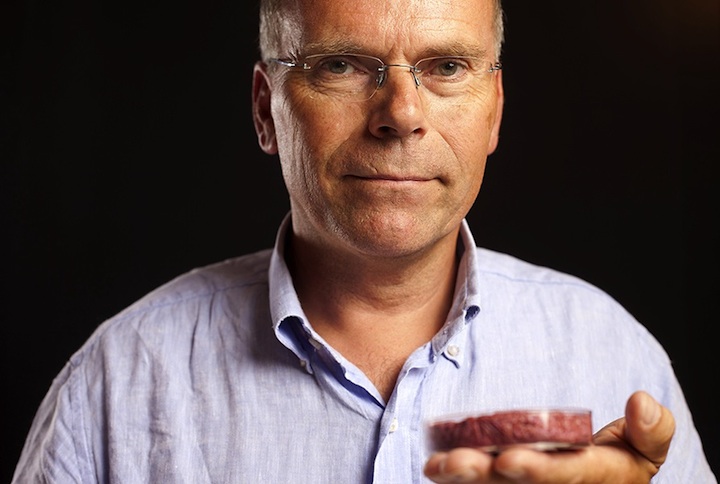
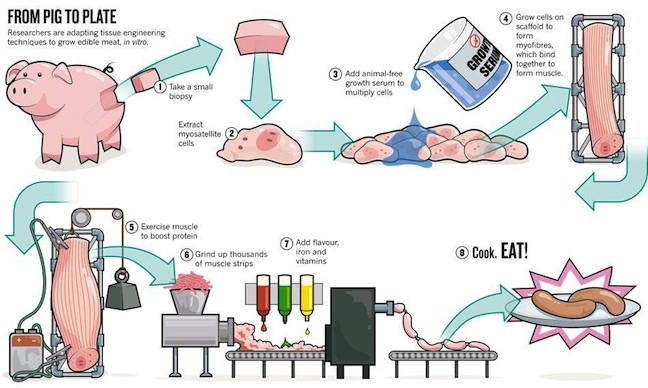
In August, a Dutch research team hosted a taste test of the world's first stem cell hamburger in London. The burger was the culmination of three months of coaxing muscle stem cells to grow and divide. The scientists from Maastricht University in the Netherlands, guided by Mark Post, isolated muscle stem cells from cows. As the stem cells multiplied and matured, they fused together to form multicellular myotubes which were then arranged in such a way as to encourage contraction and strengthening of the young muscles. This process was repeated until they obtained roughly 20,000 muscle fibers, enough to make a 5 ounce burger.
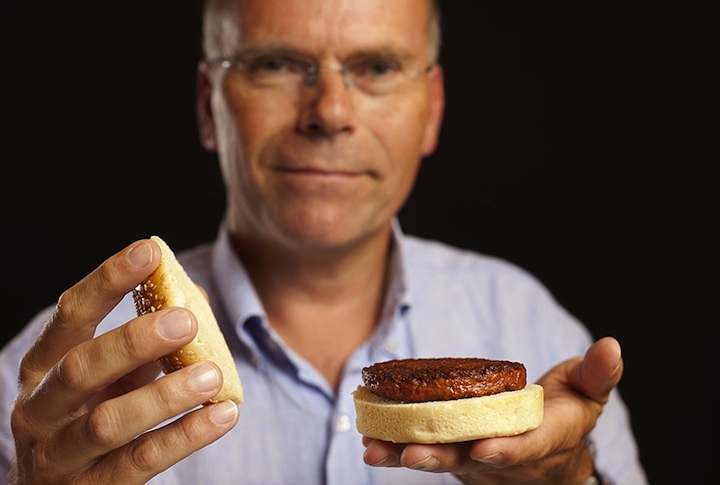
When it was time for the proof of concept, the burger was mixed with egg yolk and breadcrumbs to simulate the flavor of a traditional beef patty, and the color was enhanced by adding beet juice and saffron. The patty was fried in sunflower oil and butter and served on a sesame seed bun with slices of tomato. The judges were impressed by the authentic, meaty consistency, but added that the patty tasted quite lean. Aside from the flavor, the most prohibitory factor between "shmeat" and the masses is the price tag. That 5oz burger cost roughly $330,000 to produce!
Check out the video from Mark Post's team at Maastricht University's Cultured Beef Project below. It touches on the environmental impact of farming livestock and the benefits that the world stands to gain from growing meat in the lab.