


Hello and welcome to our third installment of Halloween themed science. Today's post is a list of three creepy parasites. Read on if you dare!
- Sacculina
- Heart Eels
- Tongue Eating Louse
This is a genus of parasitic barnacles that infests crabs and wreaks havoc on their bodies. Once a Sacculina takes hold, the crab can no longer molt, regenerate lost extremities, or reproduce. First, a female Sacculina crawls onto a joint in the crab's exoskeleton. Then, the barnacle emerges from its protective shell and enters its new host. Once inside, the parasite sends out hyphae-like tubes throughout the abdomen to siphon nutrients from the host's stomach and intestines. Sacculina then develops egg sacs that protrude from the host's abdomen in the same region as the host's own gonads. Classified as a "parasitic castrator," Sacculina destroys any chance that the host will produce offspring of its own. Now male Sacculina enter the picture and begin fertilizing the eggs. At this point, the female Sacculina, which has infiltrated the entire host's body, including it nervous system, triggers the crab's egg laying behavior. The parasite manipulates the crab into pumping its abdomen and stirring the water with its legs to disperse the Sacculina's eggs as if they were their own! If the host happens to be male, the Sacculina manipulates the male's endocrine system in order to transform its body and behaviors to resemble those of a female. In short, Sacculina are the stuff of nightmares. They invade their host, leech nutrients from its stomach and intestines, castrate it, and exercise mind control. Yikes!

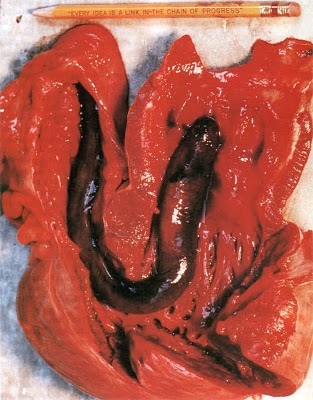
In June, 1997, parasitologists were performing a necropsy on a shortfin mako shark when they made a gruesome discovery: the shark's heart contained not just one, but two pugnose eels! Fisherman have observed this species, Simonchelys parasitica embedded in large fish before, but never completely embedded, and never occupying the chambers of the heart. Upon further investigation, the team noted histological changes in the cardiac tissue, including arteriosclerosis, hyperplasia of arterioles, and increased density of capillaries, indicating that the eels may have been there for some time. Perhaps most telling is the fact that the eels' guts were filled with blood. For the eels to survive within the heart, his means that the shark's blood was both oxygenating the eels' gills and nourishing the eels' bodies! Unfortunately, the researchers were unable to determine the path of entry, though there was speculation that the eels entered through the gills.
A shopper in Belfast was shocked to find that a fish he purchased from his local grocer was host to a Cymothoa exigua, better known as the "tongue-eating louse." C. exigua enters a host fish through the gills and makes its way to the mouth. The parasite then feeds on the blood supply to the tongue. Over time, the tongue withers away and the parasite occupies the space in the mouth that the tongue once filled. The host fish adapts to its new companion and even adopts it as a prosthetic tongue. Meanwhile, C. exigua continues to feed and even reproduce from the host's oral cavity. Jeepers!